
Home › Guides
Guide
Community eco-tourism at Periyar, seen from the outside
What eco-development means, how forest-edge villages around Periyar came to run treks and rafting, what assessments found, and how travellers can choose well.
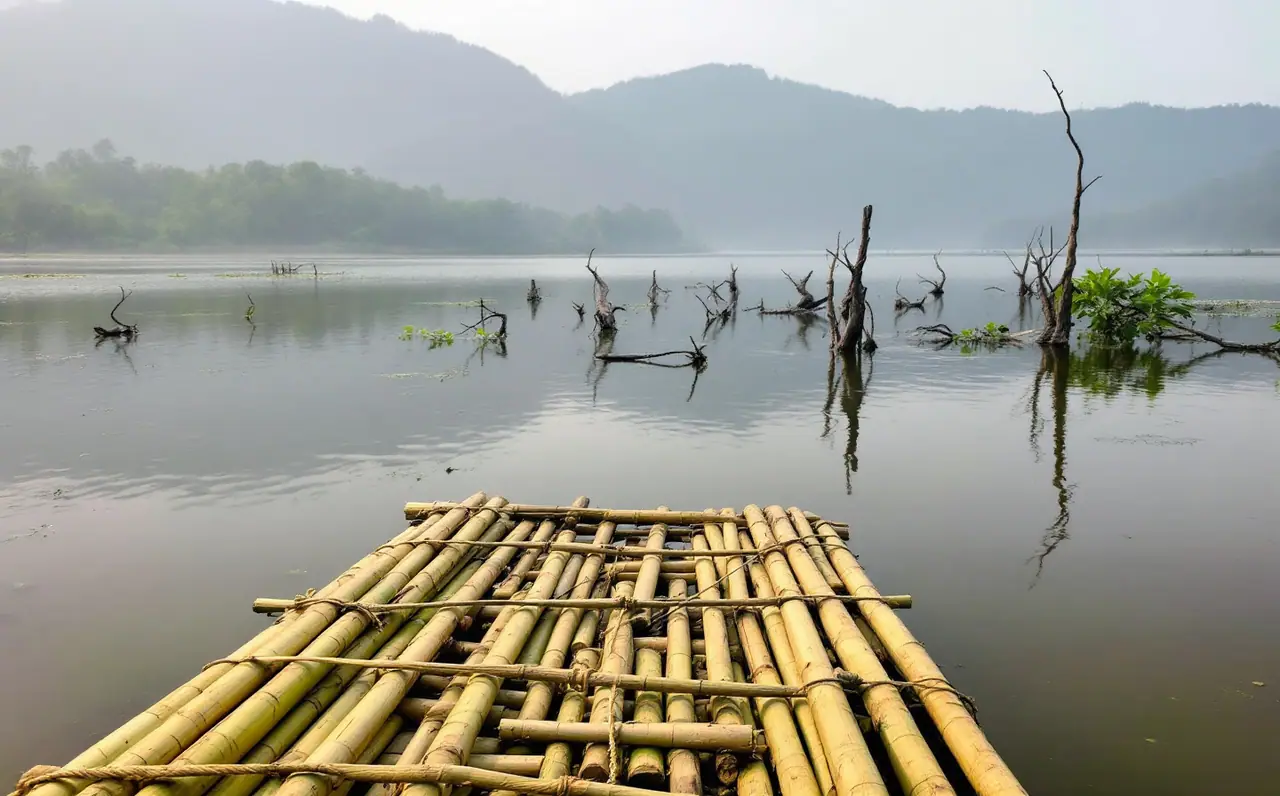
Ask people who know Indian conservation what Periyar is famous for, and many will not start with tigers or elephants. They will talk about the villages around it, and about the idea that people who once took timber, bark, fish or animals from the forest could earn a living by walking visitors through it instead. Periyar became one of the best-known examples in the country of what is usually called eco-development, and of the community-based tourism that grew out of it.
This page explains that history from the outside. We are writers and travellers who have read the published record, mainly World Bank project documents, the National Tiger Conservation Authority's material on the reserve and academic studies of protected areas in India. We describe what those sources reported at the time. Programmes change, and nothing here describes how any of them is run today. For current activities, timings and rules, check the reserve's official website or the counter in Thekkady.
What eco-development means
The basic problem is familiar wherever a protected forest has neighbours. Families at the edge need firewood for cooking, grazing for cattle, poles, thatch and leaves, and sometimes cash from forest produce. Some of that use is small and old; some, like sandalwood smuggling or poaching for meat and ivory, is serious. Rules that simply ban use without offering anything in return tend to breed resentment and quiet resistance, and forest staff end up in permanent conflict with the people around them.
Eco-development tries to change the terms. The idea is to reduce a community's dependence on the forest by investing in alternatives: better stoves and gas connections to cut firewood use, improved cattle and stall feeding to cut grazing, small loans and savings groups, skills training, village works such as water supply or school buildings, and new jobs linked to the protected area itself. In return, the community takes on commitments to reduce pressure on the forest and often to help protect it. The bargain is meant to be explicit and written down, usually in a village micro-plan.
The India Eco-development Project
The approach was tried at scale through the India Eco-development Project, approved by the World Bank in 1996 and financed through the International Development Association and a grant from the Global Environment Facility, with Indian government funds alongside. It ran in seven protected areas: Palamau, Buxa, Nagarhole, Periyar, Pench, Gir and Ranthambore, and closed in 2004.
The vehicle at village level was the eco-development committee, or EDC. Each committee brought together households in a village or settlement near the boundary, drew up a micro-plan with forest staff, managed a village development fund and agreed on what members would do in return. Communities were expected to contribute a quarter of the value of investments, which went into a fund meant to keep things going after the project.
How Periyar did it
The World Bank's completion report on the project records 72 EDCs at Periyar, covering about 5,540 households. One feature it singles out is that some Periyar committees were organised not by village but by profession or user group. People who had depended on the same forest resource, or who shared a trade, formed committees together, building on ties that already existed among them.
Other details from the same report stand out. Early funds at Periyar were used in part to help some of the poorest families clear debts to moneylenders, which the report presents as a way of building trust and breaking a cycle of poverty and poaching. EDCs took part in managing the Sabarimala pilgrimage, which brings very large crowds through the western part of the reserve each season, and women's groups joined forest patrols. The report also lists programmes aimed at tribal communities, among them tribal trekkers and a tribal heritage scheme, and the marketing of pepper.
From forest users to guides and watchers
The part of the Periyar story that travellers meet is tourism. Under eco-development, former forest-resource users and others from the fringe villages were trained and employed as guides, trekkers and protection watchers. Programmes that became well known included overnight treks and camps in the forest, often described under the name Periyar Tiger Trail, bamboo rafting on the lake, border hikes along the reserve's edge and shorter nature walks. Groups of visitors walked or paddled with local guides, some of whom had once used the same paths for illegal activity, and the guides combined their knowledge of the forest with patrolling and reporting what they saw.
A performance assessment by the World Bank's independent evaluation group, published in 2007, visited Periyar and Ranthambore and described Periyar as the most successful of the seven project sites. It recorded that converting poachers and other trespassers into eco-tourism guides had reduced poaching, and noted joint patrolling, in some cases by women volunteers, as well as efforts to promote homestead tourism around the reserve. The National Tiger Conservation Authority's note on the reserve likewise presents the change from poachers to protectors as one of Periyar's best-known achievements.
Money that stays local
Tourism also gave the arrangement a source of funds. The completion report describes a park welfare fund, an eco-development surcharge on visitors and a trust called the Periyar Foundation, set up in 2004, that receives part of visitor revenue. The idea was that some of what visitors spend would flow back into conservation and into the committees, so that eco-development could outlast the project grant. The history page places this in the longer story of the reserve.
What the assessments found
The published evaluations are positive about Periyar, but they are not uncritical, and both sides are worth knowing.
| What the reports credited | Limits, risks and cautions |
|---|---|
| Better relations between forest staff and neighbouring villages, moving from conflict towards cooperation | Benefits not reaching every village, especially along the Tamil Nadu boundary with its large estates |
| Reported falls in firewood use, forest produce collection and cattle grazing (the completion report gives about half as much firewood and produce taken, and 45 percent fewer cattle) | These figures came from the project's own participatory monitoring rather than independent long-term study |
| A sample survey of 1,500 families in which 338 moved from "very poor" to "moderate" and 200 from "moderate" to "better off" | Fluctuating prices for farm produce and the return of moneylenders could undo gains |
| Women and the poorest households included from the start, with almost half of investment support at Periyar directed to women | Power relations in villages can carry into committees, so poorer members stay marginal without continued support |
| Former poachers and forest users employed as guides and watchers | Dependence on steady funding, dedicated staff and transparent accounts |
| A foundation drawing on visitor revenue to sustain the work | Risk of elite capture and of weak dialogue with women's groups and tribal communities |
Two cautions apply to all of this. First, these are reports written around the end of a project, by the institution that funded it and its own evaluators. They draw on interviews and monitoring, and they are careful, but they are not independent long-term studies. Second, they describe a period. The way committees, programmes and funds work can change a great deal over two decades. If you want more detail on the wider research record, the piece on what research tells us about Periyar includes the eco-development studies alongside work on plants, fish, elephants and tigers.
Why it mattered beyond Periyar
What made Periyar's experience influential was less any single programme than the principle that people at the edge of a reserve could have a stake in it. The evaluation documents describe the funding model in particular, visitor revenue feeding a local foundation and village funds, as something that drew national attention. Many Indian reserves now have community-run tourism and eco-development committees of some kind, and Periyar is often cited as an early model.
How a traveller can support community-run tourism anywhere
None of this needs inside knowledge. A few habits help wherever you travel, in Kerala or far beyond it.
- Choose programmes and stays where local people are the guides, cooks and hosts, not just the background. Ask who runs the activity and who employs the guide.
- Ask where the money goes. A plain answer, such as a share to a village fund or a committee, is a good sign. Vague answers are not necessarily bad, but they are worth noticing.
- Respect the guide's knowledge and authority. They know the forest, the animals and the rules better than you do, and they are responsible for your safety. Do not press them to go closer, off-route or past closing times.
- Pay what is asked through the proper channel and tip fairly where it is customary. Do not try to arrange off-the-books trips with guides; it puts their jobs and the arrangement at risk.
- Stay in locally owned places at the forest edge when they suit you, and eat at local restaurants. The piece on choosing a homestay in spice country has questions to ask before you pay.
- Buy spices, honey, crafts and produce from local sellers, cooperatives or community outlets, and ask how and where things were made.
- Leave no rubbish, keep noise down and follow the rules on plastic and conduct. Community tourism depends on the forest staying in good shape.
- Give honest, specific feedback through the channels the programme offers. Praise a good guide by name; report real problems calmly.
Travellers are a small part of the bargain between a reserve and its neighbours, but they are the part that pays. Every visitor who takes a walk with a local guide, eats at a family-run place in Kumily and carries their rubbish back out is adding a little weight to the side of the argument that says the forest is worth more standing.
For the practical side of a visit, from getting to Kumily to a sample three days, see the Thekkady planning guide. The best question to bring with you, wherever you go, is a simple one to ask any guide on a quiet stretch of trail: how long have you walked this forest, and what has changed?