
The lion-tailed macaque, a monkey that lives in the canopy
Why the silver-maned lion-tailed macaque is found only in Western Ghats rainforest, what it eats, how troops live, and why a fed monkey is a monkey in trouble.
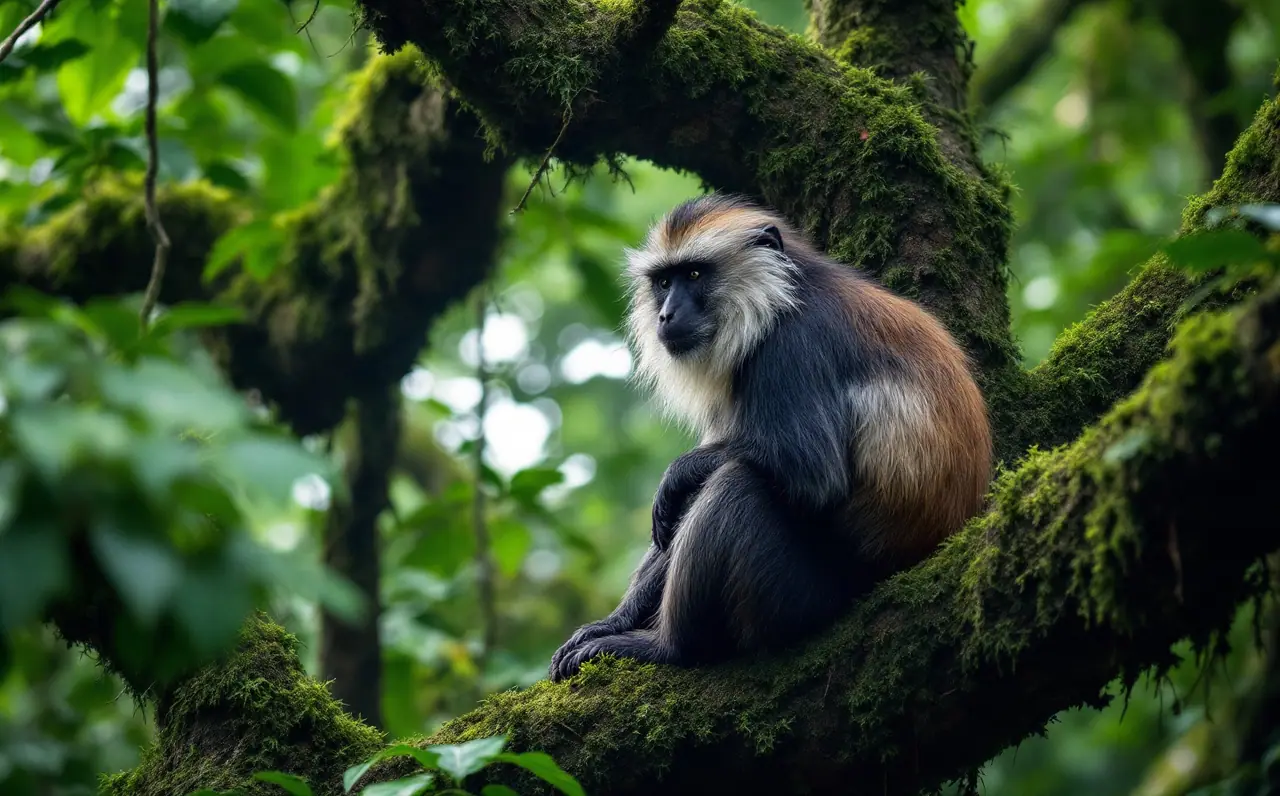
Most monkeys that visitors meet in the Kerala hills are the confident ones: bonnet macaques working a car park, or Nilgiri langurs crashing through trees beside a road. The lion-tailed macaque is a different animal. It is black, with a great ruff of silver-grey hair framing its face, and a tail that ends in a tuft like a lion's. It lives high in the canopy of evergreen rainforest, it is found nowhere outside the Western Ghats, and it is one of the most threatened primates in India.
I have never studied the species, but a good deal has been written about it, and much of that writing is clear enough for anyone to follow. This piece sums up what the published work and the main conservation sources say, and what it means for a traveller in the hills around Periyar.
Where it lives, and where it does not
The lion-tailed macaque, Macaca silenus, is endemic to the Western Ghats of southern India, with populations in Kerala, Tamil Nadu and Karnataka. It is listed as Endangered on the IUCN Red List. The population has been small for as long as anyone has counted. A conservation assessment workshop report by Sanjay Molur and colleagues in 2003 estimated roughly 3,000 to 3,500 animals in the wild, spread over many separate forest blocks rather than one continuous range.
Its home is tropical wet evergreen forest, and within that forest it prefers the upper canopy. It is not a monkey of open woodland, teak plantations or scrub. Where the evergreen forest stops, the macaque usually stops too. That single habit explains most of its story: the species is only as safe as the remaining blocks of tall, closed rainforest, and those blocks were cut into pieces over the last two centuries by timber felling, dams, roads, and plantations of tea, coffee and cardamom.
A canopy specialist
Watch a lion-tailed macaque (if you are lucky enough) and you notice how rarely it comes down. Troops move through the middle and upper layers of the forest, crossing between crowns along branches and lianas. The ground is a place they visit when they must, not where they live, at least in undisturbed forest.
Its diet is a canopy diet. Fruit makes up a large share, with seeds, flowers, young leaves, insects, snails and the occasional small vertebrate added. Researchers in the Anamalai hills found that one evergreen tree, Cullenia exarillata, a tall buttressed relative of the durian that grows in mid-elevation rainforest, supplied about a quarter of the annual diet of macaques in one forest fragment through its seeds and flowers. Figs matter too, because some species of fig are in fruit at almost any time of year. A monkey that depends on a handful of rainforest trees, many of them slow growing and patchily spread, needs a large area of intact forest to find enough food through the seasons.
In logged or degraded forest the pattern shifts. The macaques spend more time on the ground, eat more introduced plants and insects, and come into closer contact with roads, houses and people. That shift is one of the clearest signs, in the research, that a troop is under strain.
Life in a troop
Lion-tailed macaques live in groups that usually number 10 to 20 animals. Most of the troop are adult females and their young, with one to three adult males, of which one is dominant. The adult male gives a loud, carrying call that helps neighbouring troops keep their distance.
Breeding is slow. There is no fixed birth season, though births tend to cluster in the wet months. A female usually has a single infant and nurses it for about a year, and females reach maturity at around four years old, males at around six. For a conservationist that slowness is the hard fact under everything else. A population that grows slowly cannot replace losses quickly, whether those losses come from roadkill, hunting, electrocution on power lines or a troop simply being cut off in a forest patch too small to feed it.
Fragments and plantations: the Valparai example
The best-known case study of lion-tailed macaques living outside large forest blocks comes from the Valparai plateau in the Anamalai hills of Tamil Nadu, north of Periyar. Here, tea and coffee estates cover most of the plateau, and the rainforest survives as scattered fragments along streams and steep slopes.
The Nature Conservation Foundation, which has worked in these hills for many years, summarises the situation on its page about lion-tailed macaques in the neighbourhood. According to that summary, an earlier study counted 31 troops, about 460 animals, in the Anamalai rainforests, and at least 12 troops with more than 150 animals now live in fragments within the Valparai plantations. Troops in fragments cut by roads and close to houses had become used to people, raided homes and garbage, and were killed on roads more often. In one survey, most residents near a heavily used fragment said the macaques came to their houses looking for food and waste, and conflict was worse where tourists fed the monkeys.
The responses discussed there are practical rather than dramatic: monkey-proofing houses, better garbage disposal, public awareness, restoring rainforest fragments and keeping native shade trees in the plantations. What I take from Valparai is that small forest patches still matter a great deal for this species, and that how people behave around those patches decides whether the macaques there survive.
Lion-tailed macaques around Periyar
Periyar Tiger Reserve holds large areas of evergreen and semi-evergreen forest, and the National Tiger Conservation Authority's note on the reserve lists the lion-tailed macaque among its notable mammals. I have not found a published count specific to Periyar that I would repeat with confidence, so I will leave numbers out.
What matters for a visitor is where the species is not. The lake shore, the grassy edges and the boat landing near Thekkady are open habitat, and the monkeys you meet there are almost always bonnet macaques or Nilgiri langurs. Lion-tailed macaques belong to the tall, closed forest further in, away from the visitor zone, and to the evergreen stretches of the wider Cardamom Hills. If you see one at all, it will most likely be on a guided walk inside the forest, high up, partly hidden, and gone within minutes. The guide page on Periyar's wildlife gives a wider view of which animals live in which habitats.
Telling the three hill primates apart
| Feature | Lion-tailed macaque | Bonnet macaque | Nilgiri langur |
|---|---|---|---|
| Coat | Glossy black | Brownish grey | Dark brown to black, often glossy |
| Head | Broad silver-grey mane around a dark face | Cap of hair parted in the middle, pinkish face | Yellowish-brown hair on the crown, dark face |
| Tail | Medium length, with a tuft at the tip | Long and thin | Very long, held hanging |
| Usual place | High canopy of evergreen forest | Roadsides, car parks, villages, forest edges | Forest canopy, often near roads and rivers |
| Behaviour with people | Shy in intact forest | Bold, will snatch food | Wary, but used to vehicles in places |
The mane is the easy mark. Even in poor light, a black monkey with a pale ring around its face, sitting high in an evergreen tree, is worth a second look and a quiet word to whoever is guiding you.
Why feeding wild monkeys does harm
It is tempting to see a fed monkey as a happy monkey. The research and the forest-edge experience both say otherwise.
- Fed animals lose their fear of people and roads. Monkeys that wait at roadsides for food get hit by vehicles, and in fragmented habitat that loss can be a large share of a small troop.
- Food from people is poor food. Biscuits, chips, fried snacks and sweets are not what a fruit-eating canopy primate is built to digest, and plastic wrappers get swallowed with them.
- Disease moves both ways. Primates and people share many infections, and close contact over food is exactly the kind of contact that passes them on.
- Feeding teaches raiding. A troop that has learnt people carry food starts coming to houses, kitchens and bins. That is where the conflict described at Valparai begins, and conflict rarely ends well for the monkeys.
- It changes the troop itself. Animals that compete over handouts fight more, and their daily round of foraging through the forest breaks down.
The launch piece on ethical wildlife viewing covers the general habits: keep food in closed bags, eat inside a vehicle or a building rather than at a viewpoint, carry your rubbish out, and never offer anything to any wild animal. With lion-tailed macaques the stakes are simply higher, because there are so few of them and they breed so slowly.
Questions travellers ask
Can I go looking for lion-tailed macaques on my own?
Not inside the reserve. Walks and treks in Periyar are run under the reserve's own rules, with guides, and those rules change. Check the reserve's official website or ask at the counter in Thekkady for what is currently allowed. Outside the reserve, keep to public roads and paths, and do not enter private estates or forest land without permission.
What should I do if I do see one?
Stop, stay quiet and let the guide decide how close the group goes. Do not try to move to get a better angle if the macaque is watching you. A short, clear view at a distance is a good sighting.
Is the species recovering?
Sources describe a small, scattered population with real threats from fragmentation and roads, and a good deal of conservation effort aimed at both. I would not claim a trend either way without a careful, range-wide count to point to.
What should I photograph if I only get a glimpse?
The mane and the tail tuft. Those two features, even in a soft or partly hidden frame, are enough for anyone to confirm the identification later, so frame for them rather than for a perfect face.

Thara Joseph
Thara reads field studies for pleasure and turns them into plain explanations. She writes about wildlife, forests, rivers and what published research says about the southern Western Ghats.
More from the same habitat
Ethical wildlife viewing in Indian forests
Plain rules of thumb for watching wildlife in Indian forests and reserves: distance, noise, food, night lights, bird calls, geotags and elephants on the road.

Tigers of Periyar and what the monitoring shows
How camera traps and India's four-yearly tiger estimate work, what they say about Periyar's tigers, and why most visitors never see one and still come home happy.
Nilgiri tahr and the shola grasslands of the high hills
The Nilgiri tahr lives only on the grassy cliffs of the southern Western Ghats. What research says about the animal, its shola-grassland home and how to watch it.