
WildlifeForests, Rivers & Hills
Nilgiri tahr and the shola grasslands of the high hills
The Nilgiri tahr lives only on the grassy cliffs of the southern Western Ghats. What research says about the animal, its shola-grassland home and how to watch it.
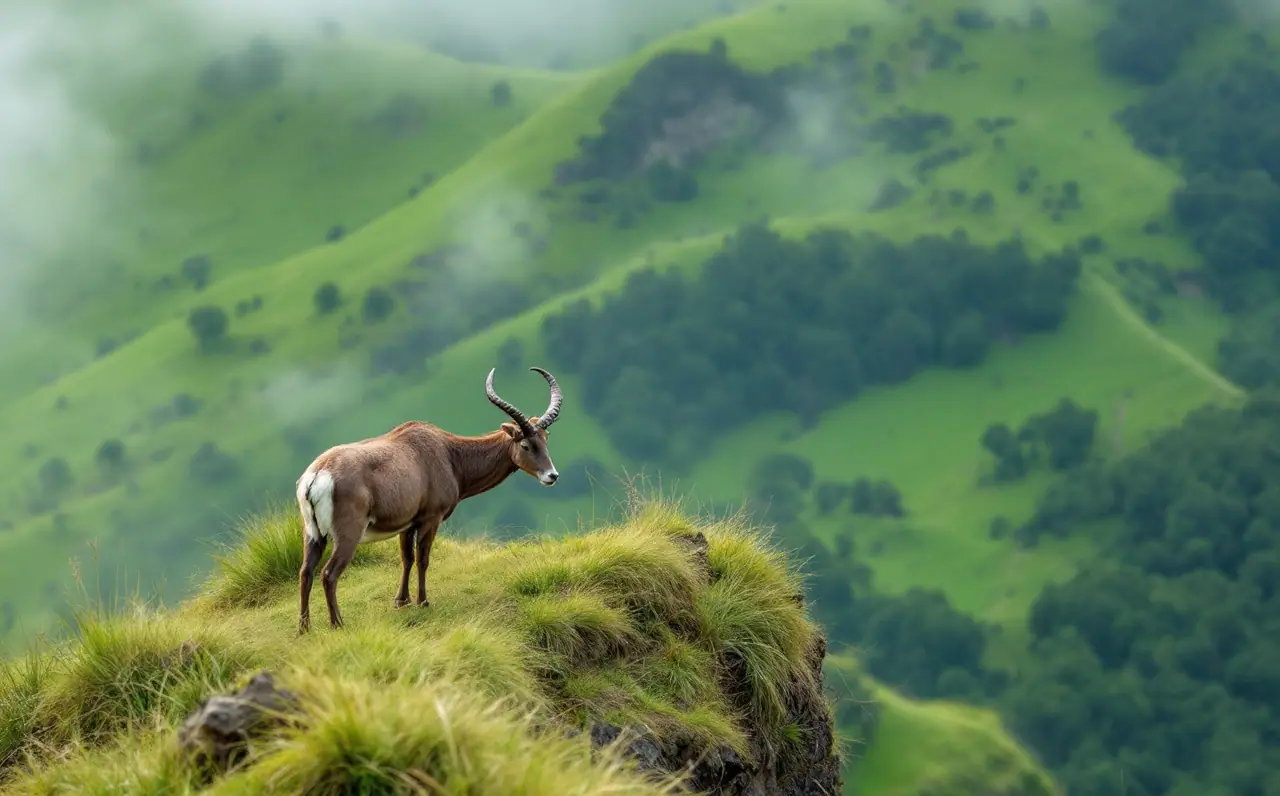
Most of the animals people come to Periyar for live in forest: elephants on the lake shore, sambar in the shade, hornbills in the canopy. The Nilgiri tahr is different. It is a creature of open grass, bare rock and wind, and it lives on the highest, steepest ground in the southern Western Ghats, where the trees give way to rolling grassland broken by cliffs. To understand the tahr you have to understand that grassland, and the small, dark forests tucked into its folds that people here call sholas.
I am not a biologist. I read field studies because I enjoy them, and this piece is my attempt to put what they say about the tahr and its home into plain words, with the sources named so you can follow them up.
A wild goat found nowhere else
The Nilgiri tahr, Nilgiritragus hylocrius, is a stocky mountain ungulate, a relative of wild goats and sheep. For a long time it was placed in the genus Hemitragus with the Himalayan tahr, and you will still see that name in older papers. Genetic work published in the mid-2000s showed it was not a close cousin of the Himalayan animal after all, and it was moved into a genus of its own. The new name keeps the "Nilgiri" in it, from the Blue Mountains where it was first described.
Adult males are dark, almost chocolate brown, with a pale patch on the back that gives big old males their local nickname of "saddlebacks". Females and young are a lighter greyish brown. Both sexes carry short, curved horns. On a cliff they move with a sure-footed calm that makes a sheer rock face look like a staircase.
The species lives only in the southern Western Ghats, across Kerala and Tamil Nadu, and nowhere else. It is listed as Endangered on the IUCN Red List, mainly because its populations are small, scattered across separate hilltops, and dependent on a habitat that has shrunk a great deal over the last century. Tamil Nadu has made it the state animal.
Where it lives
Tahr need two things close together: open grassland for grazing and steep rock for escape. Most of the places that offer both lie roughly between 1,200 and 2,600 metres, on the crests of the high ranges.
The best-known population is in Eravikulam National Park, on the rolling plateau above Munnar, where Anamudi, the highest peak in peninsular India, rises out of the grass. A survey of the Kerala side of the Western Ghats in 2001, published by Saju K. Abraham, P. S. Easa and M. Sivaram in the Zoos' Print Journal in 2006, estimated 998 tahr in Kerala spread across 11 separate populations, and put 696 of those animals at Eravikulam. The authors stressed how fragmented the rest were. You can read the summary of their survey on the journal's site.
That same survey mentioned the Kochu Pamba area, on the fringes of Periyar Tiger Reserve, as a promising stretch of habitat because it is large and little disturbed. The National Tiger Conservation Authority's note on Periyar also lists the Nilgiri tahr among the reserve's mammals. So tahr are part of the Periyar story, but they live in small numbers on remote high ground, well away from the lake and the visitor area at Thekkady. If seeing one matters to you, plan a day in the Munnar hills rather than hoping for one around Kumily. Eravikulam is the usual choice.
On the Tamil Nadu side, Mukurthi National Park in the Nilgiris and the Grass Hills in the Anamalais hold important groups, with smaller ones scattered further south.
The shola-grassland mosaic
Stand on a high ridge here and the pattern is easy to see. The slopes and rounded tops are covered in grass, pale gold in the dry months and vivid green after the rain. In the hollows and along the streams sit dense, dark patches of stunted evergreen forest with mossy trunks and a closed canopy. Those patches are sholas, and the whole arrangement is usually called the shola-grassland mosaic.
The edges between the two are often startlingly sharp. A 2012 review in the American Journal of Plant Sciences by Milind Bunyan, Sougata Bardhan and Shibu Jose pulled together what is known about why. The explanations researchers return to are frost, fire and soil. On clear nights in the cool season, cold air drains into open ground and frost settles on the grass, which kills young tree seedlings that try to grow out from the shola edge. Fire, natural and set by people, runs through the grass and stops at the moist forest margin. Over very long periods these pressures hold the boundary in place. The review also points out that many shola patches are small enough to be mostly "edge", with little true interior, which makes them fragile.
Why the grass matters
It is easy to think of grassland as the poorer cousin of forest. In these hills it does real work.
- Water. The high grasslands and sholas sit at the head of many streams that feed rivers running down to both coasts. Their deep, organic soils soak up monsoon rain and release it slowly through the dry months.
- Species. The grassland has its own plants, insects, frogs and birds, many found only on these sky islands. The famous kurinji shrubs that flower together at long intervals grow here.
- Grazers. Tahr depend on it entirely, and so do the predators and scavengers that follow them.
What is eating the grassland
The biggest change has come from trees planted where trees did not naturally grow. Through the 20th century large areas of high grassland were planted with black wattle (Acacia mearnsii), eucalyptus and pine, for tannin, fuel, pulp and timber. Some of these, wattle above all, then spread on their own into the surrounding grass.
A 2018 study in PLoS ONE by M. Arasumani and colleagues used satellite images and field checks to track land cover in the Palani Hills over about four decades. They estimated that roughly two-thirds of the native grassland had been lost, mostly to timber plantations and the spread of plantation species, with farming taking a smaller share. Their point, which stayed with me, was that people had worried for years about forest loss while the grassland, once the commonest cover on those hills, quietly became one of the rarest.
Periyar has its own version of this history. The National Tiger Conservation Authority's note on the reserve describes old eucalyptus plantations, a relic of a former grassland afforestation programme, still standing among grassland and natural forest over about 30 square kilometres.
For a tahr, a hillside of wattle is no use at all. It cannot graze under it, and a predator can approach unseen. Removing invasive trees and letting grass return is now a central part of tahr conservation in both states.
How tahr are counted
Counting an animal that lives on cliffs in cloud is not simple. Eravikulam has had regular counts for many years. In late April 2024 the forest departments of Kerala and Tamil Nadu ran their first synchronised survey across tahr habitat in both states, with teams in the field over the same few days so that animals moving across the state border would not be counted twice or missed. Published descriptions of the method mention bounded counts, where observers in neighbouring blocks compare notes on group size and make-up, and direct observation.
The Tamil Nadu Forest Department reported an estimate of 1,031 tahr for the Tamil Nadu blocks covered in that survey. I have not seen a combined figure for both states that I would trust enough to repeat here, so I will leave it at that. Counts like this are most useful when they are repeated in the same way year after year, so that a trend shows through the noise of weather and visibility.
The calving season closure
Most tahr calves are born early in the year, after a rut that runs through the monsoon months. Newborn kids are vulnerable, and mothers are wary. For this reason Eravikulam National Park usually closes to visitors for some weeks in the calving season, typically around February and March. The exact dates are set by the Kerala Forest Department each year and have shifted from one year to the next, so check official notices before you build a trip around a visit. The best time to visit Thekkady piece has more on fitting a Munnar day into the wider calendar.
How to watch tahr well
At Eravikulam, tahr in the visitor zone are used to people on the road and often graze close by. That closeness is a privilege, and it is easy to abuse. A few habits make a difference.
| Do | Avoid |
|---|---|
| Stay on the road or marked path | Climbing onto rocks to get closer |
| Keep a few body lengths back, more for mothers with kids | Walking between a mother and her young |
| Let the animal choose the distance | Following a tahr that moves away |
| Watch quietly for a while before lifting a camera | Calling, whistling or clapping to make it look up |
| Keep food packed away | Offering food or salt, which harms them and teaches bad habits |
| Carry your rubbish down | Leaving plastic that tahr may chew |
Weather shapes the experience as much as the animals do. Mist can roll over the plateau in minutes, and on some days you see grass, rock and nothing else. Early in the day is often clearer, and the light on the grass is softer. A light rain shell, a warm layer and closed shoes are worth having even when Munnar town feels mild. In the wet months, leeches appear on paths and the clouds rarely lift. The monsoon in the Cardamom Hills piece explains what that season is like in practice.
If you take photographs, a medium telephoto is plenty here. A wide shot that shows the animal small against a cliff and a sweep of grass often says more about the tahr than a tight portrait. Watch for behaviour too: kids testing their footing on boulders, a male standing stiff and side-on to show his size, the whole group freezing and turning to look downslope.
Look at the grass too
Spend a few minutes looking at what is under your feet. Notice where the shola starts and how sharp the edge is. Look for dark blocks of wattle or eucalyptus on the far hills and see how different they look from the open grass. Once you have seen the mosaic, you will spot its broken pieces all over the high ranges, and you will understand better than any figure could why an animal that needs open grass and cliffs is so rare. More species notes from the hills are collected under wildlife.
When you reach the viewpoint, give it ten quiet minutes before you leave. Tahr often reappear on a ledge you had already scanned, once the people around you have moved on.

Thara Joseph
Thara reads field studies for pleasure and turns them into plain explanations. She writes about wildlife, forests, rivers and what published research says about the southern Western Ghats.
More from the same habitat
Ethical wildlife viewing in Indian forests
Plain rules of thumb for watching wildlife in Indian forests and reserves: distance, noise, food, night lights, bird calls, geotags and elephants on the road.

What decades of research tell us about Periyar
A plain-language tour of published research on Periyar: its plants, fish, elephants and tigers, the people at the forest edge and the weeds creeping into its edges.
Tigers of Periyar and what the monitoring shows
How camera traps and India's four-yearly tiger estimate work, what they say about Periyar's tigers, and why most visitors never see one and still come home happy.