
A starter list of butterflies in the southern Western Ghats
Ten butterflies to learn first in Kerala, from the southern birdwing to the rare Travancore evening brown, with families, puddling and gentle photography tips.
I came to butterflies late, and sideways. For years they were what I looked at while waiting for birds, the flicker at the edge of the binoculars that I ignored because I had no names for it. Then I began to notice the black and green swallowtails that settle on puddles along forest roads, and I realised I had been walking past half the life of the forest. Butterflies turned out to be the friendliest way into the small creatures of the Western Ghats. They fly in daylight, they come to flowers and wet ground where you can see them, and many of the most striking ones are common.
The southern Western Ghats are rich in butterflies, with several dozen species found nowhere else on earth. Periyar alone, by published checklists, holds well over a hundred. This piece is a starter list of ten, chosen because they are distinctive, because they teach something useful, or (in one case) because they are worth knowing about even if you never see one.
Six families, in plain terms
Before the species, it helps to know the families, because shape and behaviour will often tell you the family long before you can name the butterfly.
- Swallowtails and birdwings (Papilionidae): Large, strong fliers, many with tails on the hindwing, though not all. Birdwings, mormons, roses and peacocks are here.
- Whites and yellows (Pieridae): Mostly white, yellow or orange, medium-sized, and often the first butterflies you notice in open sunny places. The jezebels belong here.
- Brush-footed butterflies (Nymphalidae): The biggest and most varied family, including tree nymphs, lacewings, yeomen, tigers, crows and the browns. Their front legs are reduced, so they appear to stand on four.
- Blues (Lycaenidae): Small, quick and easy to overlook, often with fine tails and false "eyes" on the hindwing that draw a predator's beak away from the head.
- Skippers (Hesperiidae): Stout, moth-like bodies, darting flight, often brown and orange. Plenty of beginners mistake them for moths.
- Metalmarks (Riodinidae): A small family in India, with only a handful of species. You will meet them rarely at first.
Ten butterflies to learn first
| Butterfly | Family | What to look for | Status in the southern hills |
|---|---|---|---|
| Southern birdwing | Swallowtails | Very large; black forewings, golden yellow hindwings edged in black; high, gliding flight | Widespread in forest and at forest edges |
| Malabar banded peacock | Swallowtails | Black with a broad shimmering green-blue band across both wings | Western Ghats endemic; local |
| Blue mormon | Swallowtails | Large, black, tailless; bright sky-blue on the hindwing and blue streaks on the forewing | Fairly common in forest and gardens |
| Crimson rose | Swallowtails | Black with white bands on the forewing, crimson spots on the hindwing and a red body | Common in open country and gardens |
| Common jezebel | Whites and yellows | White above; underside hindwing bright yellow with a row of red spots along the edge | Common, often high around trees |
| Malabar tree nymph | Brush-footed | Large, papery white wings with black spots; slow, floating, gliding flight | Western Ghats endemic; forest canopy and clearings |
| Tamil lacewing | Brush-footed | Orange-red above with dark borders; underside a fine lace of black and white along scalloped edges | Forest edges and clearings |
| Tamil yeoman | Brush-footed | Bright orange above with black wingtips; paler underside with a broad pale band | Common near streams and in moist forest |
| Travancore evening brown | Brush-footed | Dark brown with a violet sheen and a pale mauve band on the forewing | Endemic and rare; seldom seen |
| Blue tiger | Brush-footed | Black wings with pale blue streaks and spots; slow flight | Common; part of the seasonal migration described below |
Southern birdwing
This is the butterfly that makes people stop talking. For most of the twentieth century it was listed as India's largest butterfly. A 2020 re-measurement study, published in the journal Bionotes, gave that title instead to the golden birdwing of the Himalaya by a few millimetres, which still leaves the southern birdwing the largest in peninsular India. It is the state butterfly of Karnataka. Watch for a big black and yellow butterfly sailing along the forest edge at treetop height, sometimes dropping to flowers. Its caterpillars feed on Aristolochia vines, plants that make them distasteful to birds.
Malabar banded peacock
Kerala chose this as its state butterfly, and it is easy to see why. In sunlight the band across its black wings glows green and blue, and it changes colour as the butterfly turns. It is endemic to the Western Ghats and tends to be local rather than widespread, tied to the places where its caterpillar food plants grow. Males come down to wet mud and to flowers. When you see one, look at the band: it is the single best field mark.
Blue mormon
A big black swallowtail without tails, with a patch of sky blue on the hindwing that flashes as it flies. It visits garden flowers readily and is a good first "large swallowtail" to get to know. Its caterpillars feed on plants of the citrus family, which is one reason it is familiar around homestay gardens.
Crimson rose and common jezebel
I group these two because both carry a warning. The crimson rose, like the birdwing, feeds on Aristolochia as a caterpillar and is unpleasant to predators, which it advertises with its red body and spots. The common jezebel feeds on mistletoe as a caterpillar and is also distasteful, and its underside is a vivid pattern of yellow and red. Bright colours plus slow, confident flight usually mean "do not eat me". Several unrelated butterflies copy these patterns to share the protection, so look carefully at shape as well as colour.
Malabar tree nymph
On a forest road the tree nymph looks like a sheet of white paper drifting on air. It glides for long stretches with its large spotted wings held flat, often above the canopy and sometimes down into clearings. It is endemic to the Western Ghats and among the easiest endemics for a beginner to recognise, simply because nothing else flies quite like it.
Tamil lacewing
The lacewing you are likely to see in the Kerala hills is the Tamil lacewing. Some newer lists treat the Western Ghats population as a separate species under the name Sahyadri lacewing, so do not be surprised to see both names. The leopard lacewing that appears in some general books is mainly a butterfly of the Himalaya and north-east India. From above the Tamil lacewing is orange-red; from below it is a beautiful thing, with black and white lace work along scalloped edges.
Tamil yeoman
Tamil Nadu declared this its state butterfly in 2019. It is a bright orange butterfly with black tips, common along forest streams, and often one of the first species you find in a group on wet sand. Look at the underside when it settles: a broad pale band crosses both wings.
Travancore evening brown
This one is on the list for respect rather than expectation. It is endemic to the southern Western Ghats and very little was known about it in the wild until a population was found in Periyar in 1993. Published accounts link it with brakes of reed bamboo. Its upperside is dark with a violet sheen and a pale band; the underside is ochre and plain, like a dead leaf. Most butterfly watchers in Kerala never see it. If you think you have, a clear photograph and a careful note to a local butterfly group is the right next step.
Blue tiger
A common, slow-flying butterfly with black wings marked in pale blue. It matters here because it is one of the species involved in a remarkable seasonal movement. Krushnamegh Kunte, writing in the Journal of the Bombay Natural History Society in 2005, described danaine butterflies (tigers and crows) moving across the plains of southern India towards the Western Ghats around October and November, and back towards the plains around April and May. He documented a very large movement through Chinnar in Kerala. If you see a steady stream of tigers and crows all flying the same direction, you may be watching part of it.
Mud-puddling
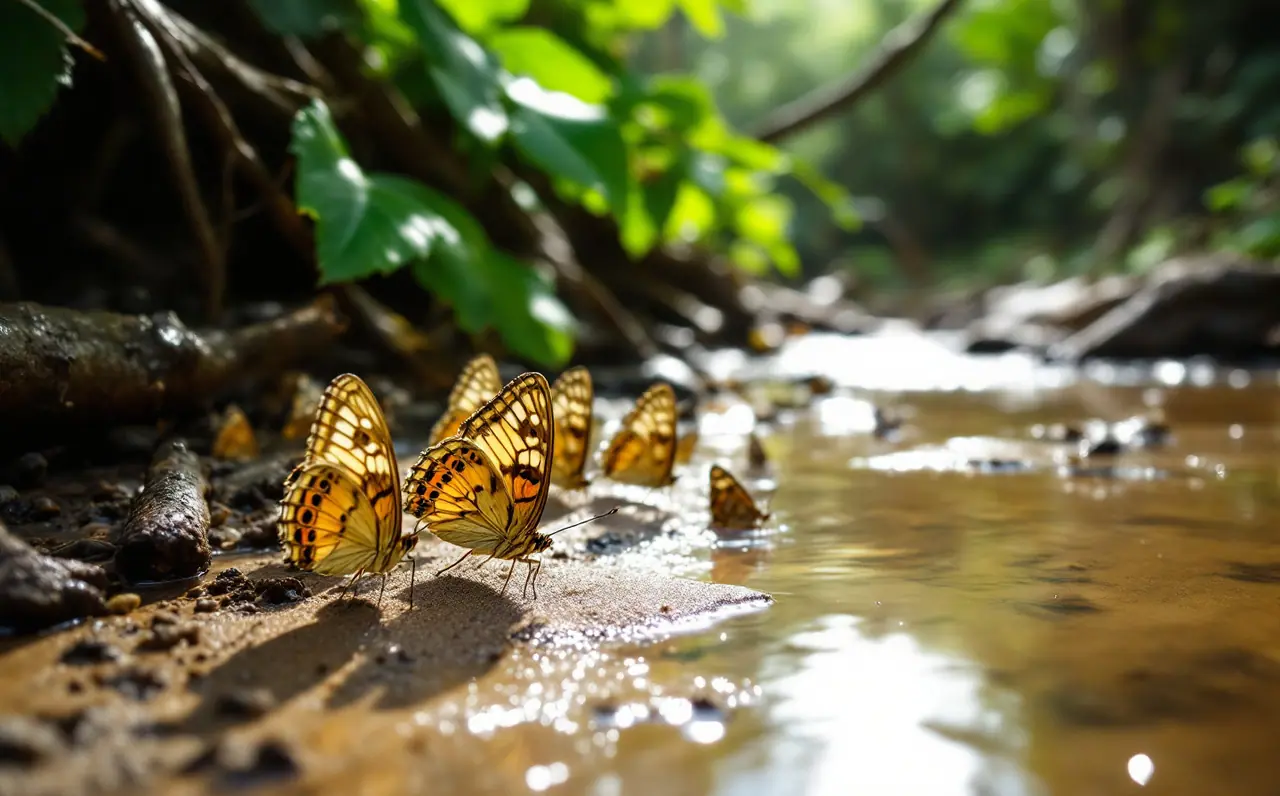
On sunny days, groups of butterflies gather on damp sand, mud, gravel and animal droppings, probing with their proboscises. Most of them are males. They are taking up salts and minerals, especially sodium, which they pass on to females during mating. Swallowtails, whites, yellows, blues and yeomen all do it, and a good puddle by a forest stream can hold several species at once. It is the best place for a beginner to compare butterflies side by side. Sit at a distance, stay low and let them get used to you.
When to look
In Kerala, the weeks after the southwest monsoon and the early part of the dry season are generally good for butterflies, roughly October through January, when plants are fresh and flowers plentiful. The hottest dry months bring fewer butterflies out in the open, though streams and puddles still draw them. During heavy monsoon rain they shelter and fly mostly in sunny breaks. Sneha's piece on the monsoon in the Cardamom Hills explains what the rains are like on the ground.
Time of day matters as much as month. Butterflies need warmth to fly, so activity picks up once the sun reaches the ground, peaks from mid-morning into the early afternoon and tails off later. That makes them a good fit with birding, which is best at dawn. Watch birds first, then butterflies. My beginner's guide to birding around Thekkady covers that early part of the day.
Photographing without chasing
Chasing a butterfly rarely ends in a good picture and often ends with a tired, frightened insect. A better approach:
- Find a puddle, a flowering shrub or a sunny perch where butterflies keep returning, and wait there.
- Move slowly and low. Keep your shadow off the butterfly; a shadow passing over it is often what makes it fly.
- Use a longer focal length so you can stay back. A macro lens around 100 mm, or a zoom with close focusing, works well.
- As a starting point in good light, try around f/8 for enough depth to keep the wings sharp, a shutter speed of 1/500 or faster, and let ISO float.
- Line the camera up parallel with the wings for a side-on view, which keeps the whole wing in focus.
- Never touch, net or hold a butterfly for a picture. The scales on its wings come off easily and do not grow back.
Kit for humid forest is covered in Rohan's packing guide for the Western Ghats, and Isaac Kehimkar's "The Book of Indian Butterflies" is a good printed reference to carry.
Start with a notebook and the common ones
The temptation is to go looking for the endemics straight away. Resist it for a while. Learn the crimson rose, the blue mormon, the common jezebel and the Tamil yeoman so well that you can name them in flight, and keep a simple record of where and when you saw them, the weather, and what they were feeding on. Within a season you will know which shrub in which garden draws which butterflies, and the rarer species will start to stand out against that familiar background on their own.

Arjun Pillai
Arjun grew up in Kottayam and has kept a bird list since a school trip to Thattekad. He writes the birding and butterfly pieces, mostly about learning to see the common species properly before chasing rare ones.
More from the same habitat
Birding around Thekkady for beginners
Where to look, when to go out and fifteen birds worth learning first around Thekkady and Kumily, from lake-edge darters to the Malabar trogon in the forest.